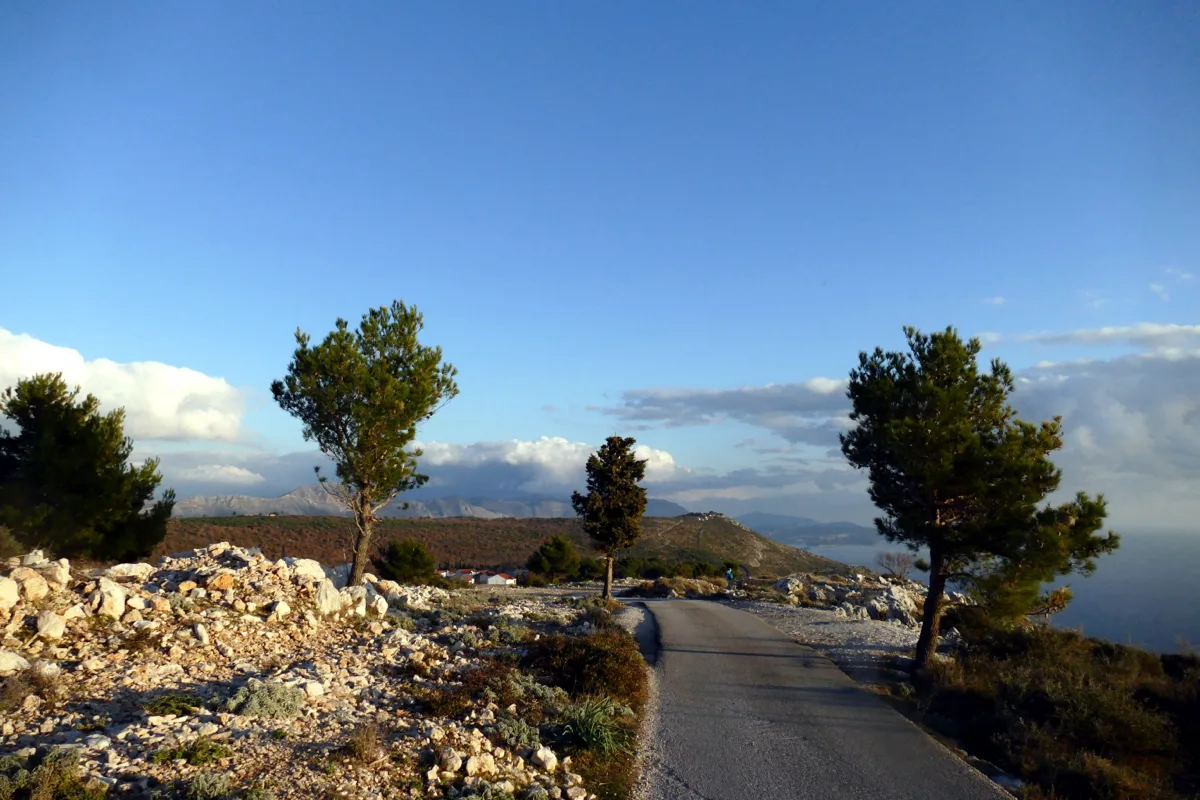
Bosanka is the hamlet on the eastern shoulder of the Srđ plateau — a cluster of stone houses, gardens and cypresses a couple of kilometres behind the summit, ten minutes’ drive from the Old Town and a world away from it in atmosphere. Our guided buggy trails cross the plateau right past it, and our registered office sits in the village, so we know its lanes better than anywhere else on the ridge. This page covers the village itself, the trail country around it, and the rules we follow when a convoy of buggies shares a lane with somebody’s grandmother’s vegetable garden. One thing it is not: the meeting point — tours depart from the upper cable-car station on Mount Srđ.
Where exactly is Bosanka?
On the karst shelf just east of the summit of Srđ, along the road that continues inland from the cable-car top station. It is a genuine hamlet — a few dozen houses, one lane wide in places — and, like the ridge it sits on, it has history heavier than its size. The village stood on the front line during the 1991–92 siege, one of the hardest chapters of the Croatian War of Independence, and was rebuilt after the war. Today it is quiet farmland and family homes with the best access of any settlement to the plateau’s trail network. Stand at the edge of the village and the geography explains itself: the summit and Fort Imperial to the west, open karst rolling east and south towards Župa bay, and the whole network of tracks fanning out from the lane you’re standing on.
How do you get there — and where do the tours start?
Two different questions, deliberately separated:
- For a buggy tour, go to the upper cable-car station on Mount Srđ — next to the Panorama restaurant. Ride the cable car up from just outside the Old Town walls (5–10 minutes; timetables sit on the tourist board’s site) or take a car or taxi up the Srđ road. Arrive about fifteen minutes before your departure: the briefing and helmets happen before anyone touches a throttle. Booked a private tour? You’re picked up at your hotel instead.
- To see the village itself, follow the ridge road east from the cable-car top station on foot — a flat, easy fifteen-minute walk with the sea views for company — or drive in on the Bosanka road from the city.
What are the trails around Bosanka like?
Classic Adriatic karst. The plateau around the village is grey limestone shelf rolling gently inland: gravel doubletrack over bedrock, loose stone in the corners, centuries-old dry-stone walls stitching the fields together, and low macchia scrub — juniper, sage, wild rosemary — filling everything in between. You smell the herbs as you drive. It rolls rather than climbs, so the driving is fun without being frightening, and viewpoint spurs branch west towards the UNESCO-listed Old City and Lokrum while the main tracks run east into empty hinterland towards the border hills. From the driver’s seat the sea keeps appearing and vanishing between the walls — one corner all grey stone, the next a slice of Adriatic blue. Expect dust in high summer — closed shoes and sunglasses are the uniform, and our what-to-wear guide covers the rest.
Which tour rides past Bosanka?
The Self-Drive Buggy Tour — 30 minutes at the wheel of a brand-new automatic Can-Am Maverick, behind a lead guide, departing every half hour from the cable-car station. The convoy works the plateau tracks between the summit viewpoints and the open karst east of the village; from €40 per adult (€50 riding solo, children 5–11 ride as passengers for €20). Drivers need a valid licence and must be 18 — part of the route uses a public road — and passengers need nothing at all. The 30-minute self-drive finale of the 3-hour private tour runs the same plateau tracks, so that route brushes the village too. Prefer to be driven the whole way? The 2-hour chauffeur option covers the city side of the ridge instead, with hotel pickup included; compare everything on our prices page.
How do we drive through the village?
Carefully — and we mean that as policy, not decoration. Bosanka is a neighbour, not a backdrop, and the trail network survives on the goodwill of the people who live along it. So every ride runs by the same rules:
- Through the lanes we move in single file at walking pace, with the guide setting the speed.
- No revving, no horns, and gentle throttle until the last house is behind us.
- We space the buggies out to keep dust off gardens and laundry lines.
- We stay on the agreed tracks — never across private land, walls or planted ground.
- No rides after dark, and the first morning convoy keeps the noise down.
Wave at people; they wave back. It is a better start to a ride than any engine note.
When is the best time to ride these trails?
Our season runs March to November, daily from 09:00 to 19:00, with self-drive departures every 30 minutes. The plateau is exposed karst, so timing matters more than it would on a shaded route: in July and August the first morning departures beat the heat and the 17:00–18:30 golden-hour slots catch the ridge at its most photogenic, while spring and autumn are comfortable at any hour and noticeably quieter on the trails. After heavy rain the limestone drains fast — the tracks are usually rideable again within hours, which is one more advantage of karst over mud, and light rain doesn’t stop a tour. If dangerous weather is forecast on the ridge, we move or refund the ride rather than run it; with departures every half hour, there is nearly always a good alternative.
What should you bring?
Closed shoes, sunglasses, sun cream and a bottle of water; the driving licence for whoever takes the wheel; and a phone or GoPro for the viewpoints. We provide helmets and the briefing at the meeting point. If you are travelling with kids, children aged 5–11 ride as passengers beside an adult; under-fives sit this one out.
The country around Bosanka is the easiest door into the landscape behind the city — we make the longer case for the hinterland in our guide to the region beyond the Old Town. When you are ready, pick a date and departure — Paula confirms every booking personally, usually within the hour.