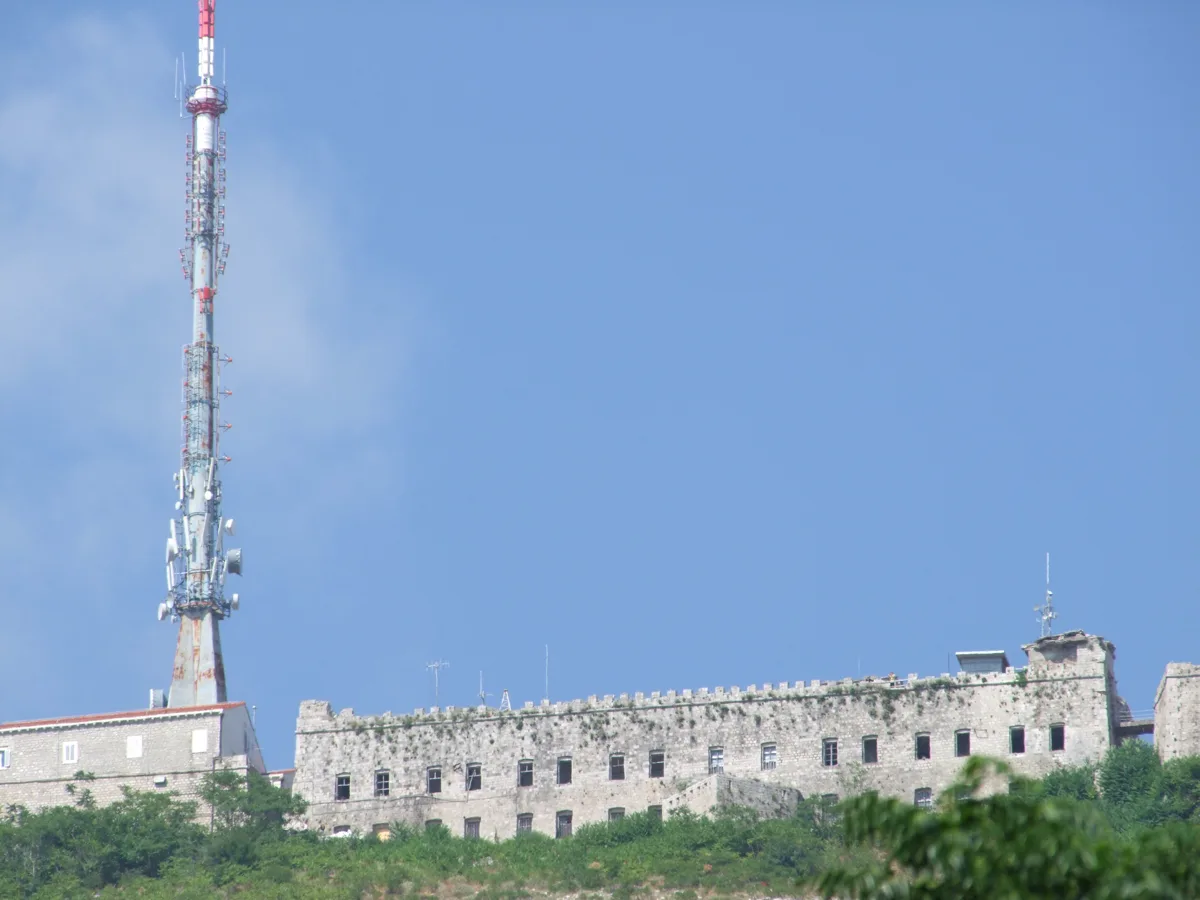
Fort Imperial is the squat Napoleonic fortress on the summit of Mount Srđ, a few steps from the cable-car top station and 412 metres directly above the Old Town. It has had two lives: built between 1806 and 1812 to hold the city for Napoleon, and defended — 180 years later — by a few dozen Croatian soldiers who kept it out of enemy hands through the siege of 1991–92. Today it houses the Homeland War Museum, its roof terrace is one of the finest viewpoints on the coast — and it stands right beside the spot where our buggy tours begin.
Who built Fort Imperial, and why?
French troops marched into the Republic of Ragusa in 1806 and formally abolished the thousand-year-old city-state two years later. Napoleon’s engineers understood immediately what the republic’s builders had always feared: the magnificent walls below were designed for a world without modern artillery, and whoever placed guns on Srđ commanded everything beneath. So between 1806 and 1812 they built a fortress on the summit and named it for the Emperor. Its shape tells you its job — low, thick-walled and hunched against the skyline, built to absorb cannon fire rather than impress anyone. After the French era ended, Habsburg garrisons kept the fort in service through the nineteenth century, which is why it survived intact into modern times.
What happened at the fort in 1991?
The fort’s second war made it a national symbol. When Yugoslav forces surrounded the city in October 1991 — the Siege of Dubrovnik — Fort Imperial was the only high-ground position that stayed in Croatian hands. A small unit of defenders, never more than a few dozen, held the old French fort through months of shelling and repeated ground attacks. The hardest test came on 6 December 1991, when the fort was assaulted directly while the city below endured its heaviest bombardment of the entire siege. The defenders held. Had they not, artillery observers on the summit would have had the whole city at their mercy. The battle is one of the defining episodes of the Croatian War of Independence, and the shrapnel scars across the fort’s stonework still read like a diary of it.
What is the Homeland War Museum like inside?
Since 2008 the fort’s ground floor has housed the Homeland War Museum, dedicated to the city’s experience of the 1991–95 war. The exhibition is compact but heavy-hitting: photographs of the burning Old Town, weapons and shell fragments, maps of the siege lines, personal effects of the defenders and video footage shot from the walls while the bombardment was happening. What gives it force is the setting — you read the story inside the very rooms the defenders held, with the shell damage still visible in the stone around the doorways. Few museums anywhere sit this precisely on their own subject.
Practicalities, phrased honestly because they shift with the seasons: the museum opens daily in the main season with shorter winter hours, and entry costs a small fee of a few euros per person, paid at the door — check current times via the local tourist board before you plan around it. Allow 45 minutes to an hour to do the exhibition justice.
What can you see from the fort?
The roof terrace is the reason half the visitors climb the stairs. Westward, the UNESCO-listed Old City sits directly below, close enough to pick out individual towers on the walls; Lokrum floats just offshore and the Elaphiti islands string away up the coast. Inland, bare karst runs to the hills of the Bosnian border — the same sightlines that made the fort worth building, and worth dying for, now doing duty as the best photography platform in the region. Early morning and the last hour before sunset give the kindest light.
When should you visit the fort?
Timing changes the experience more than most visitors expect. The summit is busiest in the two hours either side of midday, when the cable-car cabins arrive full; come before 10:00 or after 17:00 and you can have the ramparts nearly to yourself. In July and August the terrace bakes — there is no shade on the summit — so early and late visits are kinder as well as quieter. If you’re timing the fort around a ride, the golden-hour buggy departures pair naturally with a late visit — museum first, ridge after, while the light on the Adriatic goes long. Winter has its own argument: the bura wind scours the air clear, and the long views inland are at their sharpest, though museum hours shorten and you should check ahead. Our buggy tours run daily from March to November, 09:00–19:00.
How do you get to Fort Imperial?
The fort stands beside the cable-car top station, so the quickest route is the 5–10-minute ride up from just outside the Old Town walls. The Srđ road and the zig-zag hiking path reach the same summit — we compare every way up on our Mount Srđ page. And once you’re there, you’re also standing at our meeting point: the self-drive buggy departures leave from the station next to the Panorama restaurant, a few steps from the fort’s walls, before running east across the plateau past Bosanka village.
How do our buggy tours cover the fort?
There’s no separate history tour — the fort simply sits at the heart of everything we run. The Self-Drive Buggy Tour departs every 30 minutes from beside the fort: 30 minutes at the wheel of an automatic Can-Am Maverick behind a lead guide, with viewpoint stops that share the fort’s sightlines over the Old Town and the Adriatic — and guides who tell the 1806 construction and 1991 defence stories at the stops where the ground itself does half the talking. From €40 per adult, €50 riding solo. The private chauffeur tours (2 h €290, 3 h €330 per vehicle) climb to the Srđ panorama beside the fort as their finale; the 3-hour tour actually ends at the cable-car station, which makes a museum visit the perfect epilogue. Museum entry stays at your own expense and on your own clock — before or after a departure both work, since the fort is next to the meeting point. A tidy half-day, if you want one: cable car up mid-morning, the museum while the light is still hard, a half-hour in a Can-Am Maverick across the plateau, then lunch on the terrace by the Panorama restaurant. Every option is compared on our prices page, and for more background reading before you ride, see our guide to the fort and museum.
Tours run daily March to November with free cancellation up to 48 hours before the start. Choose a departure and book — and bring a spare battery for your camera, because the terrace will empty it.