
Last updated: 2026-07-04
- The best escapes from the Old Town crush are inland and offshore: the Srđ plateau, Bosanka village, the Konavle valley and the Elaphiti islands.
- Srđ and Bosanka fit in half a day; Konavle and the islands each deserve a full one.
- The ridge is ten minutes from the walls — by cable car, taxi or buggy.
- All four work from early spring to late autumn; September is the sweet spot.
Last updated:
The four escapes locals actually take are the Srđ plateau, Bosanka village, the Konavle valley and the Elaphiti islands — all within an hour of the Old Town, ranked below by how little effort they ask of you. The walls deserve their place on the UNESCO World Heritage List, and they deserve the crowds that come with it — but if your whole visit happens inside them, you will have seen perhaps two square kilometres of a region that stretches from bare limestone ridges to green wine valleys to car-free islands. I grew up directly below Srđ, and this is the list I give friends who ask what to do after day one.
What is there above the city walls?
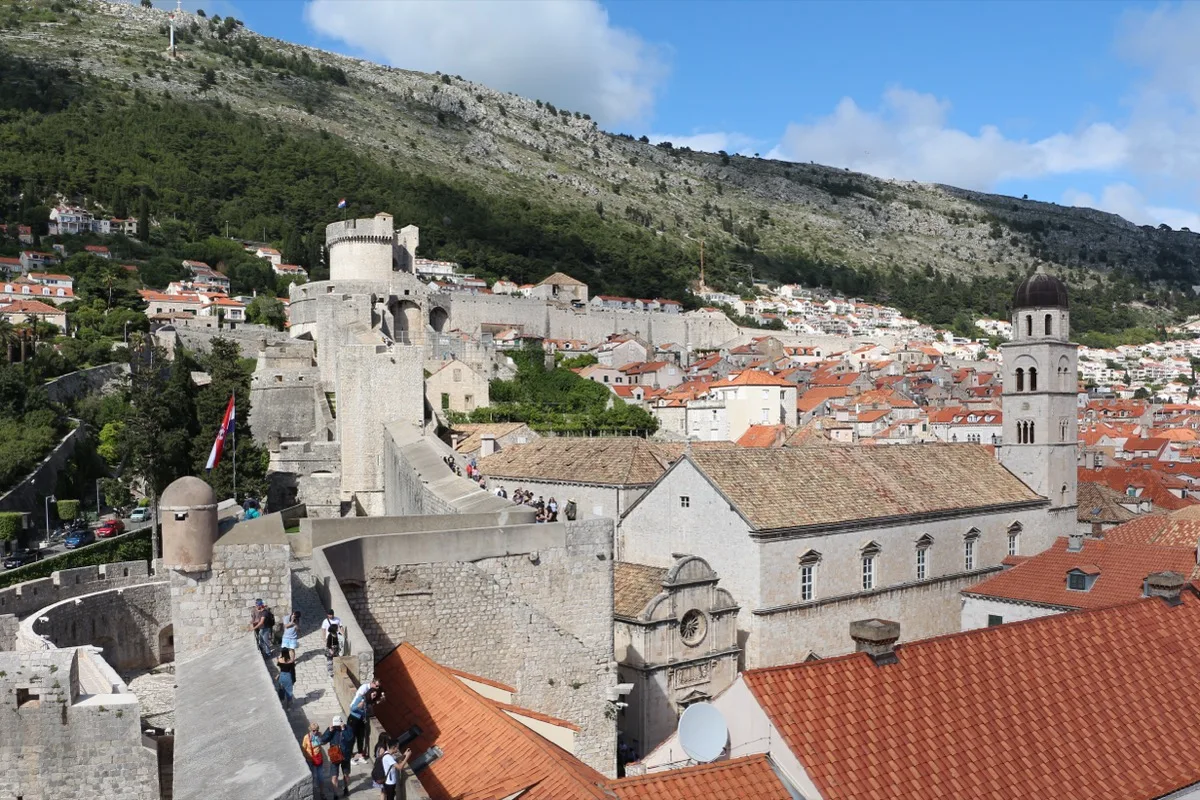
Directly above the Old Town sits the Srđ plateau — a 412-metre limestone ridge with the best panorama on this stretch of the Adriatic, and it is ten minutes away, not a day trip. From the rim you look straight down onto the terracotta roofs, across to Lokrum island, and out along the coast to the Elaphiti chain; on a clear day after the wind has scrubbed the air, the view runs far down the coastline in both directions.
Most visitors ride the cable car up, photograph the view from the terrace, and descend within the hour. That is the postcard version. The plateau behind the viewpoint is the interesting part: kilometres of gravel trails through sage and low karst scrub, the Napoleonic bulk of Fort Imperial with its Homeland War Museum, and viewpoints the terrace crowd never reaches. We run our buggy tours across exactly this ground, straight out of the cable-car top station — the Mount Srđ buggy tour page maps the route — but the plateau rewards anyone who gets past the terrace, on four wheels or two feet.
Why is Bosanka worth a stop?
Because it is the last working village on the plateau, and it is where the tarmac gives way to the trails. Bosanka sits a ten-minute drive from the Old Town gates, yet it belongs to a different century: dry-stone walls, small vineyards and gardens, a church, and grazing land running out towards the ridge line. There is no souvenir stand in sight.
For walkers, Bosanka is the natural base for exploring the plateau without the cable-car queue: paths lead from the village towards Fort Imperial and the viewpoints above the coast road, including the outlook over Žarkovica with the whole Old Town harbour laid out below. For our guests it is the village the buggy trails thread past — the Bosanka village trails page covers what the surrounding tracks actually look like. Either way, the village is the easiest possible proof that the region does not end at the walls.
What makes Konavle different?
Konavle is the green, agricultural south — the strip of Croatia between Cavtat and the Prevlaka peninsula, and the closest thing the region has to a wine country. Where the coast around the city is vertical rock, Konavle is a flat, fertile valley backed by mountains, planted with vines, olives and cypress. The local white grape, Malvasija dubrovačka, nearly vanished in the twentieth century and is now the pride of a handful of family cellars that pour it straight from the barrel.
Three stops anchor a Konavle day. Cavtat, the harbour town at the valley’s mouth, stands on the site of ancient Epidaurum and has a waterfront promenade that feels like the Old Town with nine-tenths of the people removed. Čilipi hosts folklore performances in traditional Konavle dress on summer Sunday mornings in front of the parish church. And the restored fortress of Sokol Grad, hard against the cliffs at the valley’s inland edge, is a proper medieval eyrie with views over the entire valley. Background on the region’s unusual history — it was the last territory the Republic of Ragusa ever purchased — is on Wikipedia’s Konavle page. Count on 35–45 minutes’ drive each way and give it a full day.
Are the Elaphiti islands worth a full day?
Yes — they are the easiest island escape on this coast, and the contrast with the city could not be sharper. The Elaphiti Islands string out northwest of the city, and the three inhabited ones each have a distinct character. Koločep is the nearest and smallest: pine woods, two hamlets, swimming coves, no cars. Lopud, also car-free, has the archipelago’s showpiece — Šunj, a shallow sandy bay on the island’s far side, one of the very few true sand beaches in the region. Šipan is the largest and quietest, all olive groves and half-abandoned summer palaces of Ragusan nobility.
The practical part: regular ferries leave from Gruž harbour and call at all three islands, so you can do one island slowly or two at a pace. Timetables thin out outside high season — check them the day before rather than at the quay. If you only have energy for one, most locals would send a swimmer to Lopud and a walker to Šipan.
How do you fit it all into a short stay?
The honest answer for a three-day visit: walls and Old Town on day one, the ridge on day two, and either Konavle or the islands on day three. This table is the planning shortcut:
| Trip | Time needed | Getting there | Best for |
|---|---|---|---|
| Srđ plateau & Fort Imperial | Half a day | Cable car, taxi or guided buggy | Views, war history |
| Bosanka & the plateau trails | Half a day | 10-min taxi, or cable car + walk | Village quiet, off-road trails |
| Konavle valley | Full day | Car or organised tour, ~40 min | Wine, folklore, Cavtat |
| Elaphiti islands | Full day | Ferry from Gruž | Swimming, car-free calm |
| Trsteno Arboretum | Half a day | ~25 min by car or bus, north | Renaissance gardens |
Trsteno earns its bonus row: a Renaissance arboretum built around a fifteenth-century Gučetić family estate, with a pair of giant plane trees at the village crossroads that are worth the trip on their own. Seasonal notes apply to everything above — ferry and event schedules are fullest June to September, and the tourist board site keeps current listings for the whole region. September remains my favourite month for all of it: sea still warm, light softer, crowds halved.
Do you need a car for any of this?
Only for Konavle, honestly — everything else runs fine on public transport, taxis or your own feet. The ridge and Bosanka are a ten-minute taxi ride or a cable-car trip from the walls; the Elaphiti ferries leave from Gruž, which every local bus route seems to pass through eventually; and Trsteno sits on the coastal bus line towards Ston. Konavle is the exception because its charm is spread across a whole valley — Cavtat at one end, Sokol Grad at the other, cellars in between — and connecting those dots without a car means either an organised tour or a patient day of local buses.
If you do rent a car for a day, combine Konavle and Cavtat into one loop and keep the islands for a car-free day; parking at Gruž and ferry timing make mixing the two a headache. And if driving on holiday only appeals when the road is gravel and the speed is your own, well — that is a different vehicle entirely.
None of these trips needs special planning, and that is rather the point — the region beyond the walls is close, cheap to reach and startlingly empty by comparison. If the plateau is the part that appeals, that one we can help with directly: the three-hour private buggy tour strings the harbour, the bays and the ridge viewpoints into a single chauffeured loop — with the wheel handed to you for the final half hour.