
Last updated: 2026-07-04
- Srđ is the 412 m limestone ridge directly above the Old Town, with the finest panorama on this coast.
- Four ways up: cable car (~4 minutes), the Serpentina footpath (60–90 minutes), the road via Bosanka, or a guided buggy tour.
- Fort Imperial, built under Napoleon in 1806–1812, crowns the summit and houses the Homeland War Museum.
- The original 1969 cable car was destroyed in the 1991 siege and reopened in 2010.
Last updated:
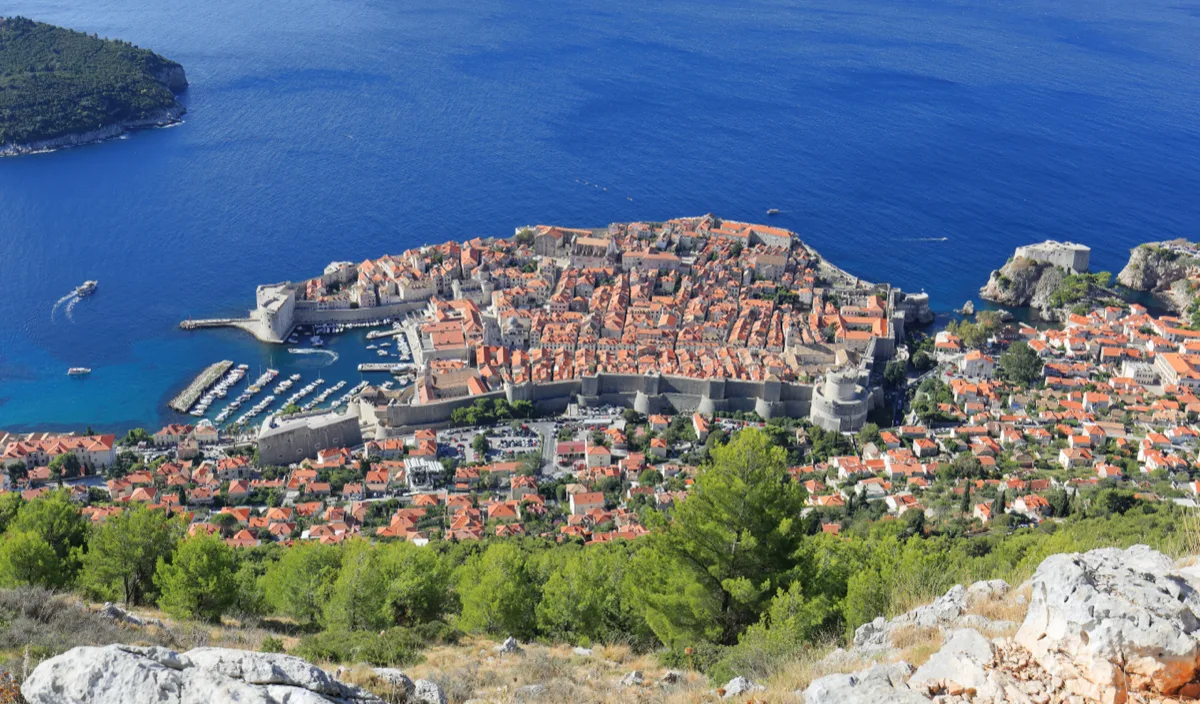
Every photograph of the Old Town that seems to have been taken from a drone was almost certainly taken from Srđ. The ridge rises straight behind the city walls to about 412 metres, close enough that you can pick out individual boats in the old harbour, high enough that Lokrum, the Elaphiti islands and the open Adriatic arrange themselves into one enormous view. I have worked on this mountain for ten years, and this guide covers everything people ask me on it: how to get up, what the fort is, what happened here in 1991, and whether to walk, ride or drive.
What is Mount Srđ?
Srđ is a bare limestone ridge — part of the karst wall that runs along this whole coastline — standing immediately north of the Old Town, with a summit plateau rather than a peak. The rock is pale, the vegetation is low sage and scrub (the pine forest that once covered the slopes burned during the war and in later summer fires), and the top is a broad, walkable plateau that stretches back towards Bosanka village and the hinterland. Geography and history in more depth are on Wikipedia’s Srđ page.
The summit cluster is compact: the cable-car top station with its viewing terrace and restaurant, the stone bulk of Fort Imperial a short walk away, a large stone cross, and a forest of antennas. The view is the reason everyone comes — but the plateau behind it, laced with gravel trails and old military roads, is where the mountain gets interesting.
How do you get to the top of Srđ?
Four ways: cable car, footpath, road, or guided buggy — and they suit four different kinds of visitor.
| Way up | Time | Effort | Best for |
|---|---|---|---|
| Cable car | ~4-minute ride | None | The classic view, fast |
| Serpentina footpath | 60–90 min up | High — no shade | Hikers, sunrise walkers |
| Road via Bosanka | ~15-minute drive | None | Drivers, off-peak visits |
| Guided buggy tour | ~45 min (30 min driving) | You drive | The plateau beyond the terrace |
The cable car is the famous option, and its biography mirrors the city’s. The original line opened in 1969 and carried millions up the ridge until the 1991 siege destroyed it; the rebuilt system opened in 2010, and the ride from the lower station just outside the walls takes around four minutes. The Serpentina — the zig-zag path that switchbacks up the south face — is free, steep and completely exposed: fine on an April morning, brutal at 2 p.m. in July, so carry water and check the forecast at meteo.hr before committing. The road winds up through Bosanka village and reaches the summit area from behind. And the buggy tours — our patch — start right at the upper cable-car station and cover the plateau’s trails and viewpoints that none of the other three options touch; the Mount Srđ buggy tour page shows the route.
What is Fort Imperial?
Fort Imperial is a Napoleonic fortress, built between 1806 and 1812 while the French controlled the city, and it has watched over every chapter of local history since. The French recognised immediately what defenders had always known: whoever holds Srđ holds the city below. The fort they left — a squat, thick-walled stone square a few minutes’ walk from today’s cable-car station — served Austrian, Yugoslav and Croatian forces in turn over the following two centuries.
Its defining hour came in 1991, when a small Croatian garrison held the fort through the siege against sustained attack — the reason the building now houses the Homeland War Museum on its ground floor, with photographs, weapons and film from the defence. The walls still carry shrapnel scars, which makes the exhibition unusually direct: you look at a photograph of the damage, then at the damage. Practical details, opening context and what to pair it with are on our Fort Imperial page.
What happened on Srđ in 1991?
Srđ was the key ground of the siege — the city’s fate below depended on the ridge holding, and it held. From October 1991, Yugoslav People’s Army forces surrounded and shelled the city during the Siege of Dubrovnik, part of the wider Croatian War of Independence. Shells fell on the UNESCO-listed Old Town itself — the damage assessments that followed are documented in the World Heritage listing — and the heaviest single assault came on 6 December 1991, when the fort’s few dozen defenders fought off a day-long attack on the summit.
Riding past the fort today, the contrast is hard to process: the same ground that decided a siege is now a viewpoint where visitors photograph cruise ships. Our tours pause at the viewpoints by the fort for exactly that reason — the story lands differently when you are standing on the ground where it happened, with the whole once-besieged city visible below.
What is the cross on the summit?
The stone cross near the cable-car station was first raised in 1935, wrecked by shelling during the siege, and rebuilt after the war — making it, like the cable car and the fort, a survivor with a scar history. It stands at the plateau’s edge in direct line of sight from the Old Town, and when it is lit at night you can find it from the Stradun by simply looking up. Most visitors walk past it for the view beyond; knowing its dates makes it worth the pause.
Should you hike up, ride the cable car, or drive?
Match the transport to what you actually want from the mountain. If you want the postcard panorama with minimum time spent, the cable car wins — four minutes each way, terrace, done in an hour. If you want to earn the view, the Serpentina is a proper leg-burner with the reward growing behind you at every switchback; go at sunrise or in the last two hours of daylight, never at midday in high summer. If you have a rental car, the Bosanka road gets you up for free and works in winter when other options thin out.
And if the plateau itself is the attraction — the trails, the fort, the viewpoints beyond the terrace railing — that is what the buggy tours are for. The self-drive buggy tour departs from the upper cable-car station every 30 minutes, you drive your own Can-Am buggy behind a guide, and a standard car licence is all you need. As one Google review puts it:
Such a fun experience with amazing views and lovely people! Highly recommend! ❤️
— Charlotte Wetton · Google review
When is the best time to go up?
The last two hours before sunset, in any month — the light turns the limestone gold, the islands go into silhouette, and the terrace crowds thin as the tour groups head down to dinner. Second-best is early morning, especially the day after the bura wind has blown through and scrubbed the air; those are the days the visibility seems endless. Avoid the middle of a July or August day on foot entirely, and note that services on the summit run reduced schedules outside the main season — the tourist board site keeps current information.
However you go up, go. Srđ is the cheapest great view in southern Croatia if you walk it, the fastest if you ride the car, and — we would argue — the most fun if you drive it: check dates for the Mount Srđ buggy tour and see the plateau properly.